As water utilities push toward smarter, more data-driven operations, one question continues to shape the industry: to DMA — or not to DMA?
Monitor > Prioritize > Act – that’s how utilities turn network data into measurable NRW reduction and operational efficiency.
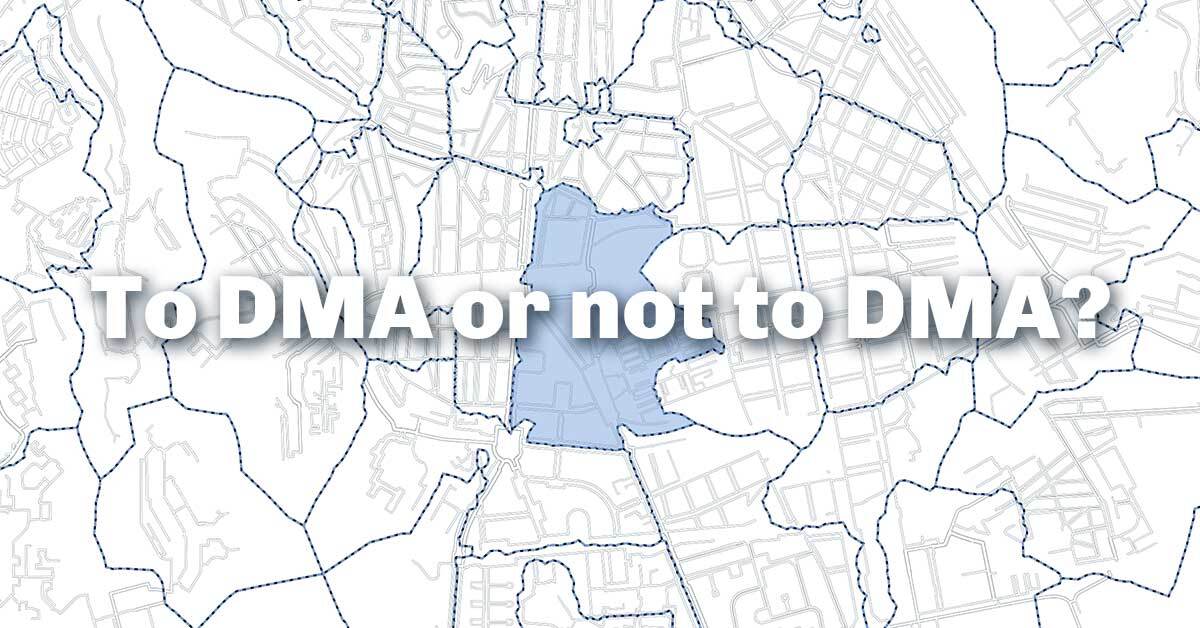 District Metered Areas (DMAs) have long been the foundation of leakage management. By subdividing distribution networks into smaller sectors, utilities can monitor flows, identify leaks faster, and improve non-revenue water (NRW) control. This approach has been widely adopted across Europe and other global markets as a core strategy for improving network intelligence.
Unsurprisingly, DMAs come with tradeoffs. Even if payback is usually short, they require initial capital investment. They often require network modifications, and may reduce operational flexibility. In dense or mature systems, implementation can be complex — leaving many utilities, especially in the U.S., hesitant. But this is not different from what utilities in Europe and other parts of the world experienced when they started implementing district metering, and experience shows there are several ways to ease those.
All-or-nothing vs. opportunity-driven
Turning an entire system on to DMAs in one go would be a daunting prospect anywhere. But most water systems already have existing partitions – distribution areas, pressure zones with one or two inlets, etc – that can easily be turned into metering districts by simply adding a flowmeter or two. vDMAs are another option to consider: parts of the system that have relatively few contact points with the surrounding network(s), and can be turned into a fully metered district by monitoring those inlets/outlets, rather than physically isolating the network. This leverages near real-time consumption data, sensors, and advanced analytics to monitor performance and detect anomalies — delivering many of the benefits of traditional DMAs without the infrastructure burden.
Start small, learn, then expand
Starting by turning easy opportunities into DMA/vDMAs has the obvious advantage of water loss management done right in those sectors. It has, however, an even greater value: accelerating a learning curve for the utility, in how to build, manage and leverage DMA/vDMAs, that will allow much better planning, use of resources and fewer mistakes when expanding to the rest of the network, than would inevitably happen if doing it all in one go.
Where is the value? The value, however, isn’t just in creating sectors — it’s in what utilities do with the data.
Effective monitoring requires:
- Continuous flow and consumption analysis
- Reliable event detection and demand prediction
- Integration of AMI, billing, and operational data
- Prioritization of leakage response based on actual losses
Without the right analytics and management tools, even well-designed monitoring programs can fall short of delivering meaningful operational impact.
The future of smart water isn’t about choosing one approach — it’s about using better data, smarter segmentation, and advanced software to monitor, prioritize, and act.
Get in touch to find out how Baseform can help your utility manage your DMAs, vDMAs or other sectors for next-level water loss management.